Every April, Cambodia welcomes the arrival of Khmer New Year, known in Khmer as Choul Chhnam Khmer (ចូលឆ្នាំខ្មែរ). Across the country, pagodas fill with prayers, families gather, and villages burst into traditional games and joyful celebrations.
The first moment of the new year is called Moha Sangkrant (មហាសង្ក្រាន្ត). For most people today, the word simply means the beginning of the Khmer New Year. Yet behind this familiar term lies a remarkable story—one that stretches back more than a thousand years, connecting Cambodia to ancient astronomy, Sanskrit language, and the intellectual world of the Angkorian empire.
A Word Born from the Movement of the Sun
The word Saṅkrānta (សង្ក្រាន្ត) originates from the Sanskrit term saṅkrānti (संक्रांति). In Sanskrit, the word comes from:
- sam – together or completely
- krām / krānti – to step, move, or pass
Together, saṅkrānti literally means a transition or movement from one place to another.
In ancient Indian astronomy, this word had a very specific meaning: the moment when the sun moves from one zodiac sign into the next. Since the zodiac contains twelve constellations, there are twelve Sankrantis every year, each marking the beginning of a new solar month. For many cultures influenced by Indian astronomy, these solar transitions became important points in the ritual calendar.
Sankranta in the Stones of Angkor
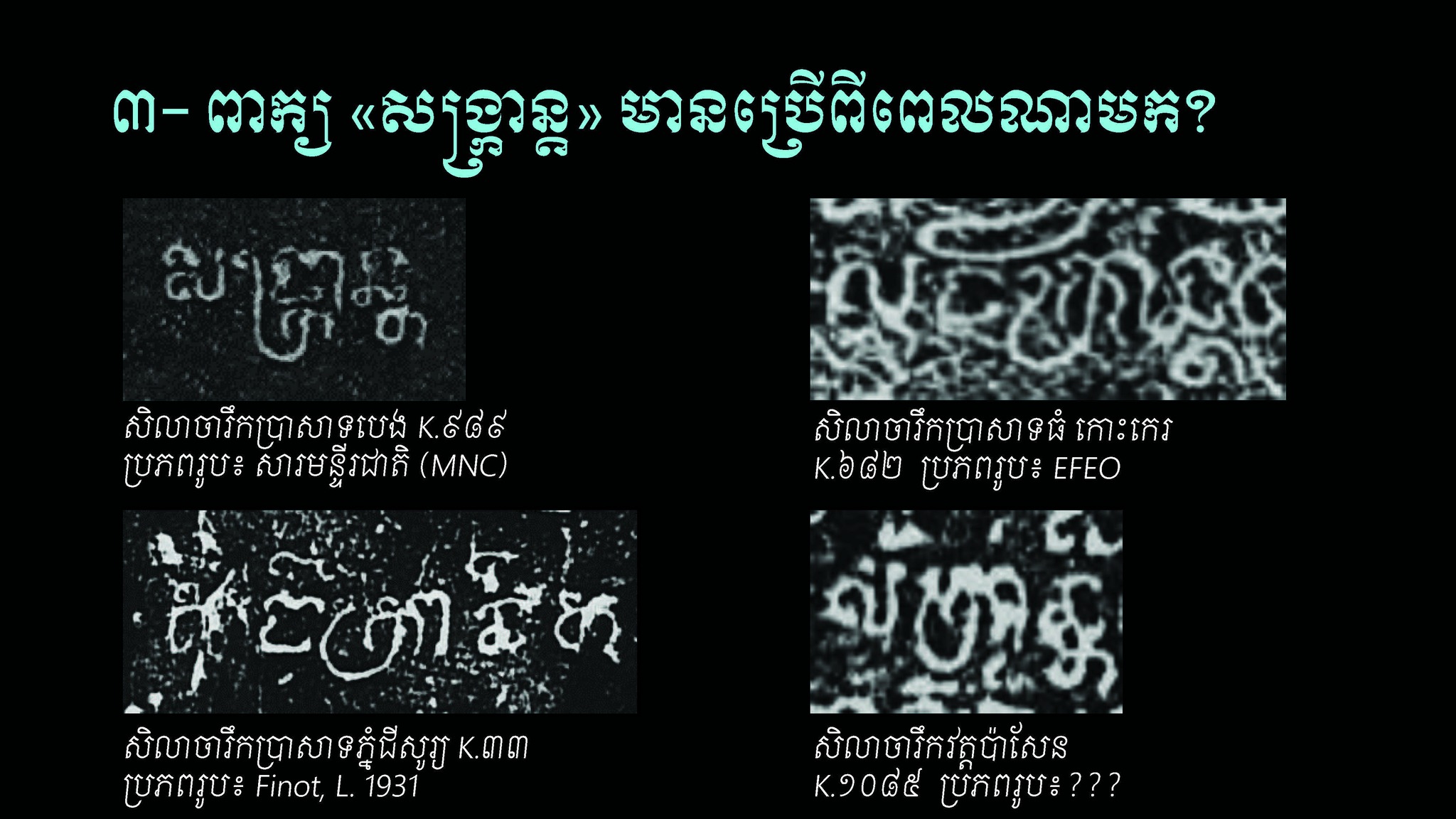
Long before the modern Khmer New Year celebrations we know today, the word Saṅkrānta already appeared in the inscriptions of the Khmer Empire. Researchers have identified the word in almost 100 Angkorian inscriptions containing variations of the word, including សង្ក្រាន្ត, សងក្រាន្ត, សង៑ក្រាន៑ត, and សំក្រាន្ត. These inscriptions appear in temples such as Prasat Phimean Akas (K.291) dated 910 CE, Prasat Thom at Koh Ker (K.682) dated 921 CE, Prasat Phnom Chisor (K.33), confirming that the word was already widely understood during the early Angkorian period as early as 10th century.
Interestingly, scholars have not found the word in inscriptions before Angkor or after the Angkor period, suggesting that it was particularly significant during the height of Khmer civilization.
A Date for Temple Offerings
Surprisingly, these inscriptions rarely describe celebrations. Instead, most references to Sankranta are connected with temple donations. In nearly all cases, the inscriptions record offerings such as milled rice (អង្ករ), servants dedicated to temples, agricultural land, and ritual supplies. This suggests that Sankranta functioned primarily as a calendrical marker used for organizing religious donations and temple administration. Rather than a festival, it was originally a moment in the ritual calendar when offerings were made to deities or temples.
The Evolution of Calendar Use Among the Khmer People
During the Angkorian period, the Khmer kingdom used the Saka Era (Mahāsakaraj / មហាសករាជ) as its principal chronological system. Originating in India in 78 CE, the Saka calendar spread across Southeast Asia together with Sanskrit scholarship, Hindu cosmology, and Indian astronomical knowledge. Cambodia adopted this system by at least the 5th century, and it remained the primary framework for dating inscriptions and organizing ritual calendars throughout the Angkorian era. Notably, even after the kingdom transitioned from Hinduism to Theravada Buddhism, Cambodia continued to use the Saka era rather than adopting the Buddhist Era for chronological reckoning.
In 638 CE, a new calendrical era known as Culāsakaraj (ចុល្លសករាជ) —meaning “the Lesser Saka Era” in Pali—was established in the Pyu city of Sri Ksetra. Chulasakaraj was essentially a regional recalibration of the Saka system, preserving the same Indian astronomical principles while introducing a new epoch for counting years. Over time, this system spread widely across mainland Southeast Asia, including Myanmar, Siam, Laos, and Cambodia. By the post-Angkor period, Cambodia gradually adopted Chulasakaraj-based calculations for its traditional lunisolar calendar.
Despite this transition in calendrical systems, Khmer terminology remained consistent. The Sanskrit-derived term Sankranta continued to denote the solar transition when the sun enters Aries (Mesha Sankranti), which marks the beginning of the new year.
Why Cambodia Celebrates Mesha Sankranti
Different societies chose different Sankranti to mark their new year. For example, Tamil communities celebrate Makar Sankranti, when the sun enters Capricorn, because it corresponds to their agricultural cycle.
Cambodia, however, celebrates Mesha Sankranti (មេឝ- ឬ មេសសង្ក្រាន្ត)—the moment when the sun enters Aries (មេឝរាសី), the beginning of a new zodiac cycle. This transition occurs around April 13–14 each year and marks the official beginning of the Khmer New Year. The first moment of this solar transition is called Moha Sangkrant (មហាសង្ក្រាន្ត), meaning “the Great Solar Transition.”
In this agrarian society, the timing of this solar transition in mid-April also coincides with the post-harvest season, a natural pause in the agricultural cycle that allowed communities to gather and celebrate.
How Cambodians Calculate the New Year Today
Cambodia today uses a few calendar systems at the same time, each serving a different role in society.
- For official administration, business, and everyday life, the country follows the Gregorian calendar, the international system used around the world.
- For religious purposes, many pagodas and Buddhist texts use the Buddhist Era (ពុទ្ធសករាជ), which counts years from the passing of the Buddha.
- However, when it comes to traditional festivals and astrology, Cambodia still relies on the traditional Khmer lunisolar calendar.
Even though Cambodians no longer count years using Chulasakaraj numbers, its astronomical formulas are still used to determine important events, including the exact moment of Moha Sangkrant, the beginning of Khmer New Year.
From Astronomy to Celebration
More than a thousand years ago, Sankranta simply described the movement of the sun. It was a technical astronomical term recorded in temple inscriptions and used to organize ritual offerings.
Over centuries, however, the word gained new meaning. Today, the great solar Sankranta evokes celebration, family gatherings, temple visits, and joyful renewal across Cambodia. Yet hidden inside the word is a reminder of the Khmer world’s deep connections to ancient astronomy, Sanskrit scholarship, and the sophisticated calendrical knowledge of Angkorian civilization.
Every year, when the sun enters Aries and Moha Sangkrant arrives, Cambodia celebrates not only a new year—but also a tradition shaped by more than a millennium of history.
