
 Before you start reading, put on: Khmer Theme from Sid Meier’s Civilization VI Medieval Age | Khmer Rourm Sam Mawgee ខ្មែររួមសាមគ្គី — the playful, bright notes of the roneat ek dancing overhead, carrying something of that uplifting spirit toward the golden age of Khmer civilization.
Angkor Wat is one of the most photographed monuments on Earth, but long before it became a travel-blog staple, it was already showing up in a quieter corner of pop culture: video games. From 1990s arcade cabinets to modern grand-strategy epics, developers have reached for Angkor’s towers, the carved faces of the Bayon, and the root-tangled walls of Ta Prohm whenever a setting needed to feel ancient and imposing. Some games use this only as backdrop. Others build entire civilizations, unique units, and playable leaders around it. Either way, a surprising number of players have encountered a version of Cambodia’s legacy on screen well before they could place Angkor on a map.
This is a rundown of that legacy: strategy games that let you rule the Khmer Empire, action-adventure titles that made Angkor a stage for global stardom, arcade and fighting games that used it as a familiar backdrop, a mobile phenomenon that looped back into the real world, a few titles that borrowed its architecture without naming it outright, and the small number of games actually made in Cambodia.
Strategy Games: Playing as the Khmer
Age of Empires II: Rise of the Rajas
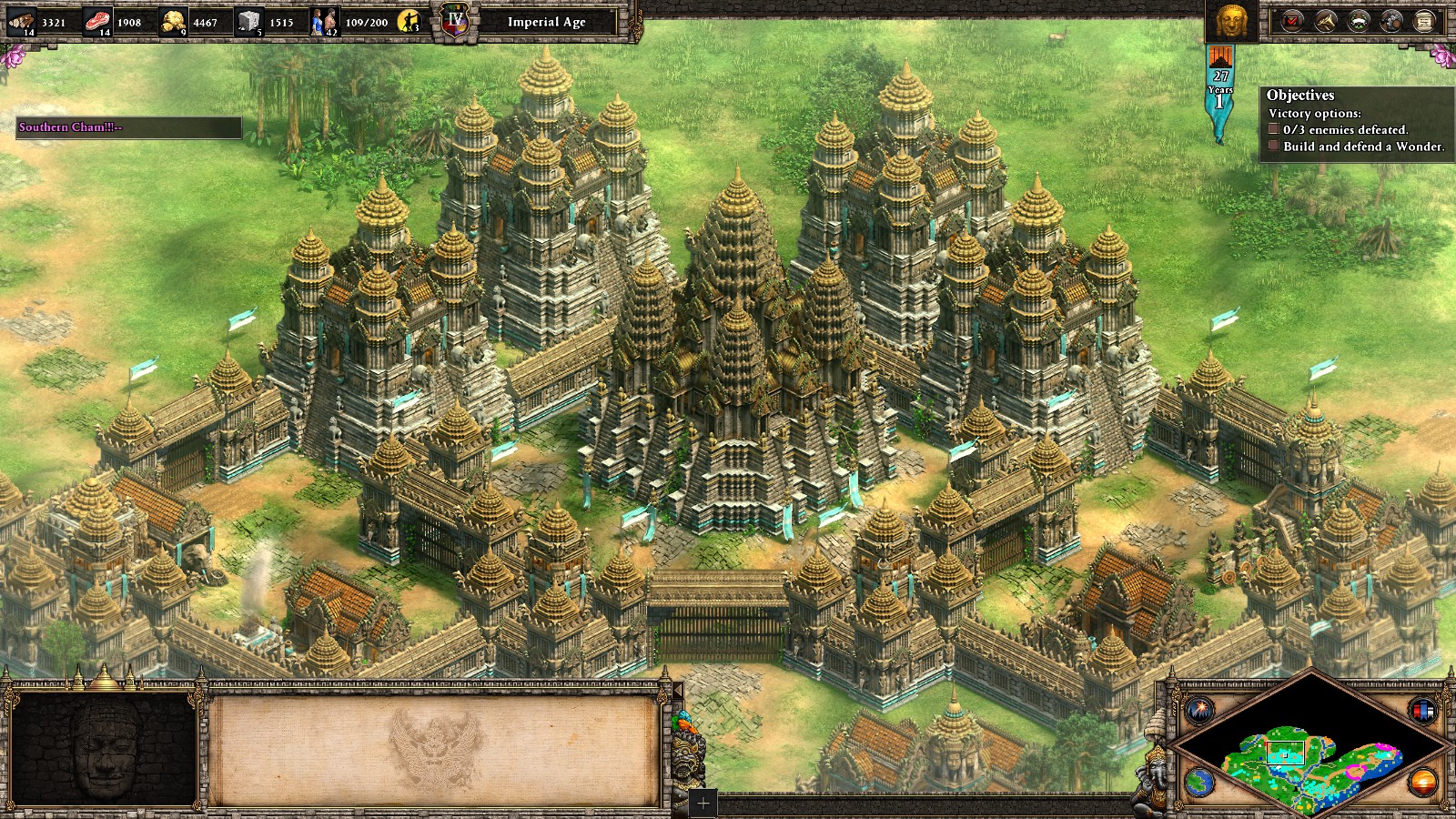
When Age of Empires II launched in 1999, its civilization roster leaned heavily on Europe, the Middle East, and East Asia. Southeast Asia wasn’t part of the original lineup. That changed in 2016 with the Rise of the Rajas expansion, which added the Khmer alongside the Malay, Burmese, and Vietnamese.
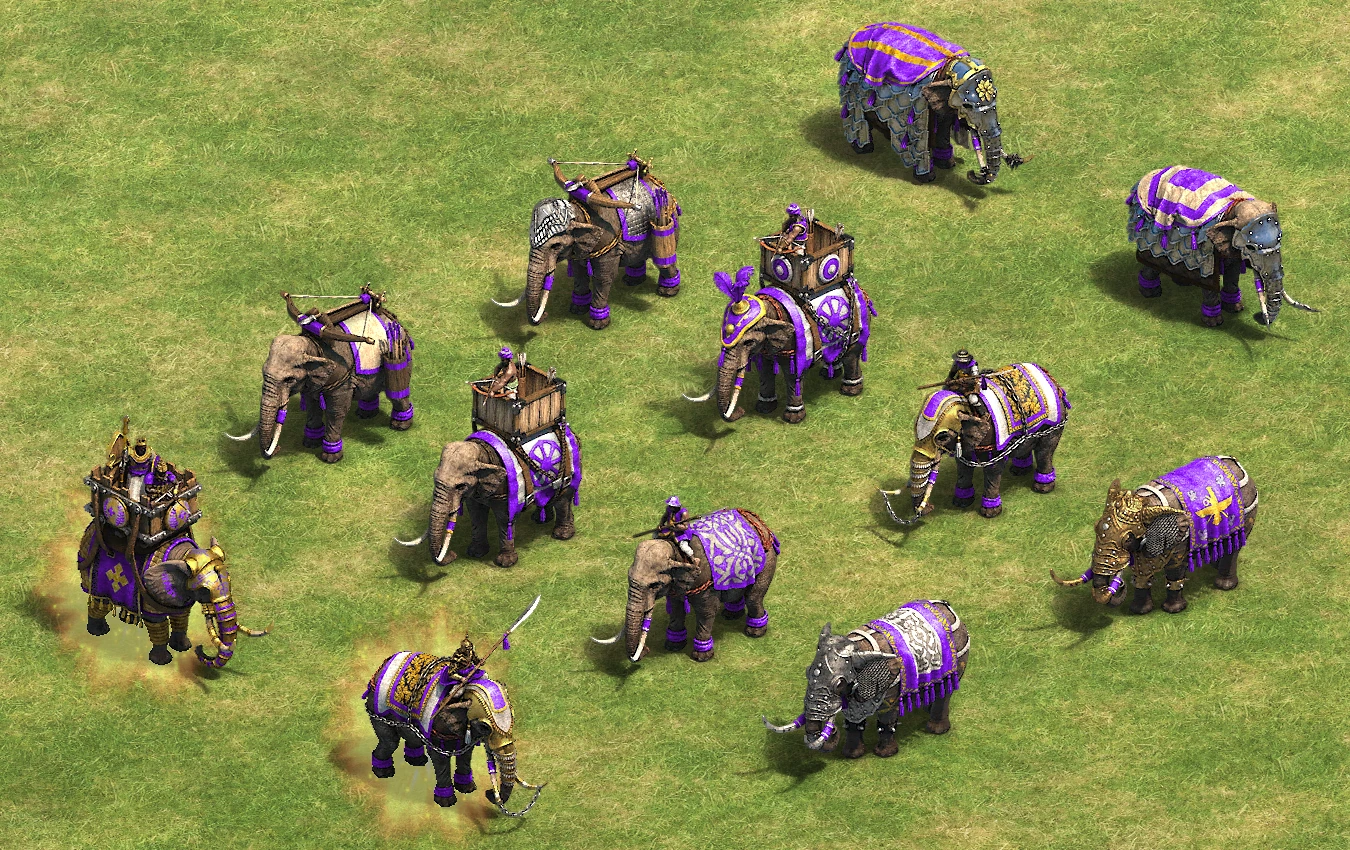
In-game, the Khmer are built around two things the historical empire was genuinely known for: elephants and siege warfare. Their unique unit, the Ballista Elephant, is based on a real Angkorian weapon — a war elephant carrying a mounted crossbow-like ballista, considered one of the more sophisticated pieces of Khmer military engineering and sometimes compared to the Roman carroballista. In the game it fires bolts like a mobile Scorpion siege engine, can chop down trees, and upgrades with the unique technology Double Crossbow to fire two bolts at once. Paired with Tusk Swords, a buff for regular Battle Elephants, the Khmer end up as one of the more elephant-focused civilizations in the series.
Their civilization bonus fits the theme too: Khmer players can build any structure or advance an Age without needing prerequisite buildings — a loose nod to how quickly the historical empire raised temples and infrastructure. The in-game lore text also covers the empire’s decline: internal strife, agricultural pressure from a cooling climate, the shift from Hindu devaraja kingship to Theravada Buddhism, and territorial losses to Siam, ending with King Ponhea Yat abandoning Angkor in 1431.
Sid Meier’s Civilization VI: Khmer and Indonesia Civilization & Scenario Pack
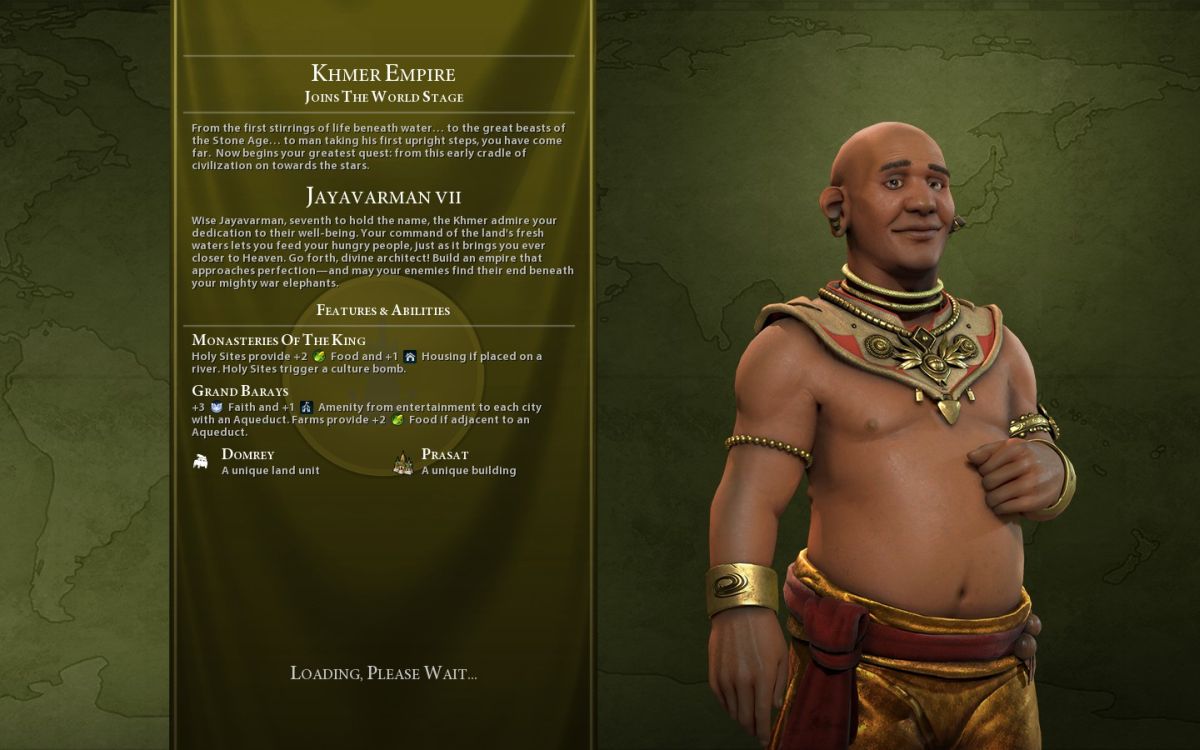
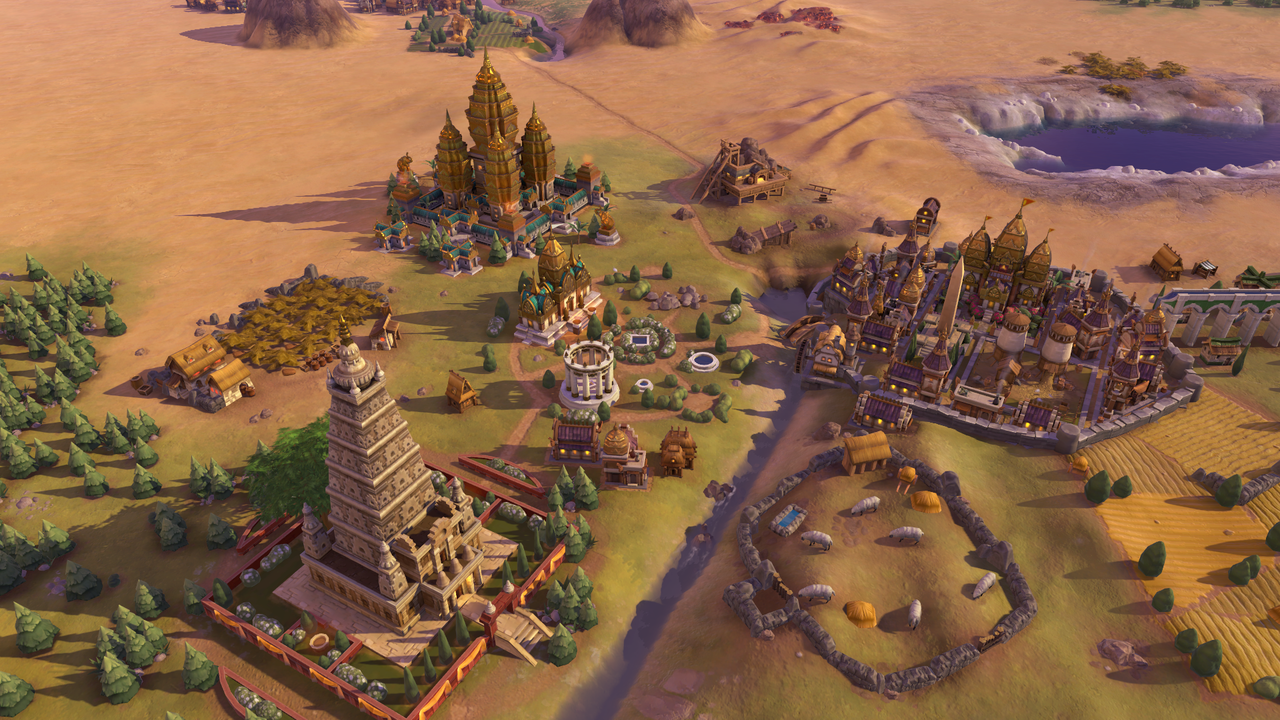
Where Age of Empires puts you in charge of the Khmer at war, Civilization VI hands you the empire as a builder. Released in October 2017, this DLC pack made Jayavarman VII — builder of the Bayon and much of Angkor Thom — a playable leader.
His leader ability, “Monasteries of the King,” nods to his real building projects: Holy Sites built next to rivers grab extra territory and generate Food and Housing. The civilization ability, “Grand Barays,” references Angkor’s barays, the man-made reservoirs that irrigated the empire’s rice economy — in-game, Aqueducts provide Faith and Amenities, and adjacent Farms get a food bonus, a light mechanical echo of the hydraulic network that once supported one of the largest pre-industrial cities on the planet.
The unique unit is the Domrey (“elephant” in Khmer), a ballista-mounted elephant that replaces the Trebuchet and can move and fire in the same turn. The unique building, the Prasat, replaces the Temple and ties into the civilization’s religious focus — missionaries killed in theological combat generate a Relic instead of simply disappearing. Concept artist Samuel Aaron Whitehead illustrated the pack’s promotional art, and the DLC came with a “Path to Nirvana” scenario on a custom Southeast Asia map. Among players, Jayavarman VII is generally considered a strong pick for a Religious Victory, thanks to the Faith his populous, river-based cities can generate.
The soundtrack is worth a mention on its own. Composer Geoff Knorr built the Khmer theme around two traditional melodies, “Khmer Rourm Sam Mawgee” (ខ្មែររួមសាមគ្គី, “Khmer Gather Together”) and “Kawnsaing Snai” (កន្សែងស្នេហ៍, “Love Scarf”). The Ancient Era arrangement features the roneat ek, the lead bamboo xylophone of the Pinpeat ensemble — Cambodia’s largest traditional orchestra, historically used in royal courts, temple ceremonies, and classical dance. Those parts were performed by Song Heng, a musician who has played traditional Khmer music since childhood and regularly returns to Cambodia to perform. Because the roneat ek’s tuning doesn’t map cleanly onto Western instruments, later-era arrangements substitute marimba, played by Doug Perry, with an ethnic flute part from Sandro Friedrich in the Medieval version. Knorr has said in interviews that sourcing Khmer music was harder than most other civilizations’ themes: unlike Indonesian gamelan, which is well documented, Khmer traditional repertoire nearly went extinct by the late 19th century and survives largely through musicians like Song Heng. It’s a piece several players and fans single out as one of the more affecting tracks in the Civilization series.
Civilization VII (2025) later gave the Khmer a new Antiquity Era theme built around the Apsara Dance (Robam Tep Apsara), this time performed by a full Pinpeat ensemble credited as Wong Pleng Khmer — a further step toward representing the music at something closer to its original scale.
Action-Adventure: Angkor as a Stage
The Tomb Raider Series
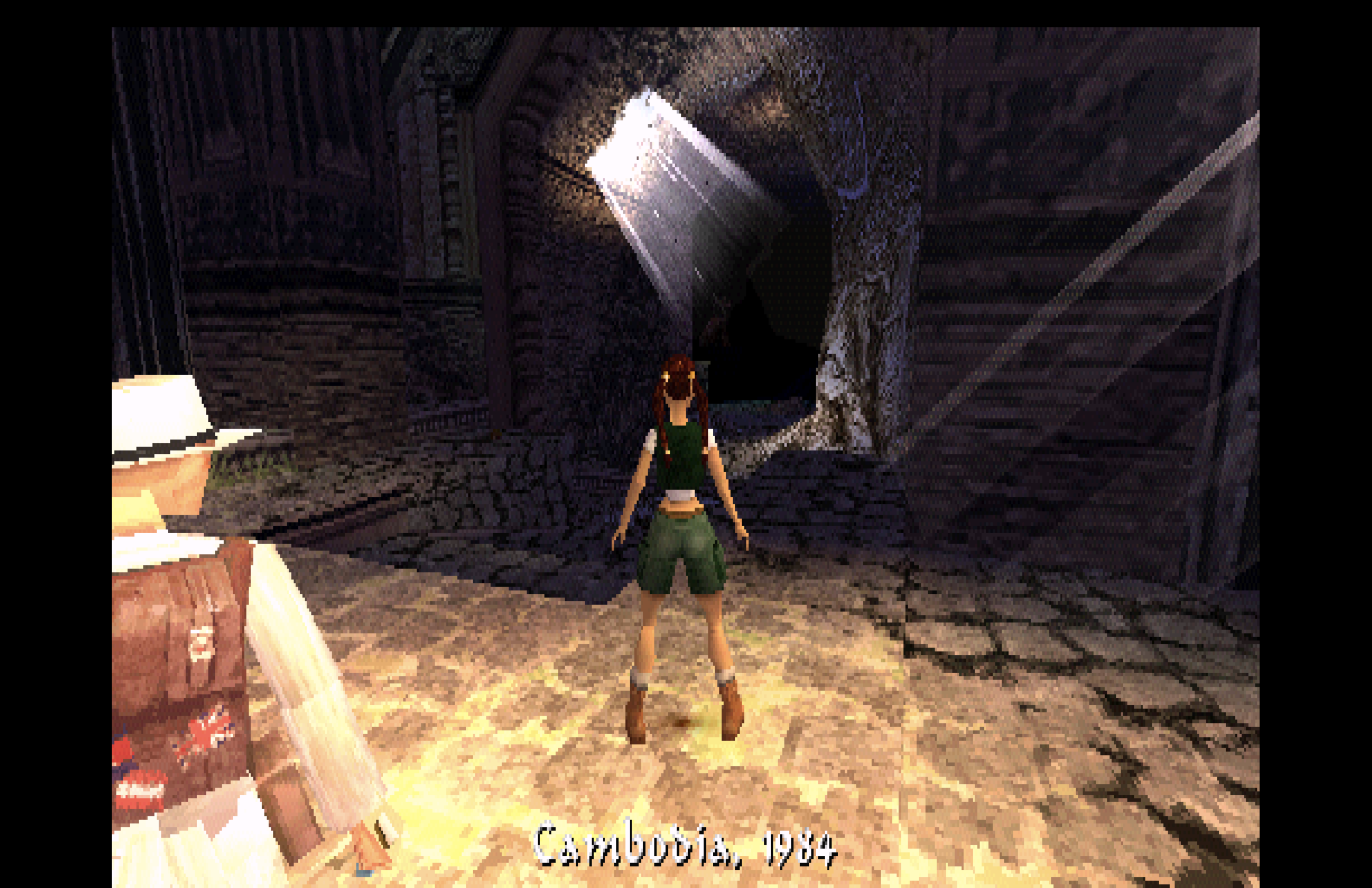
Tomb Raider is probably the franchise most responsible for putting Angkor in front of a Western audience. Lara Croft first visits Cambodia in Tomb Raider: The Last Revelation (1999), where a young Lara, accompanied by her mentor Werner Von Croy, explores Angkor Wat at the very start of the game, collecting Golden Skulls before the main story begins.
The connection deepened with the 2001 film adaptation, whose Cambodia scenes were filmed on location — Angelina Jolie’s Lara at Angkor Thom’s Bayon temple, then at Ta Prohm, the 12th-century Buddhist monastery entangled in the roots of silk-cotton and strangler fig trees. That shoot gave Cambodian tourism a real boost: Ta Prohm is still nicknamed “the Tomb Raider temple” by guides and travel sites, even though it had already stood root-wrapped and half-swallowed by jungle for eight centuries before Jolie arrived.
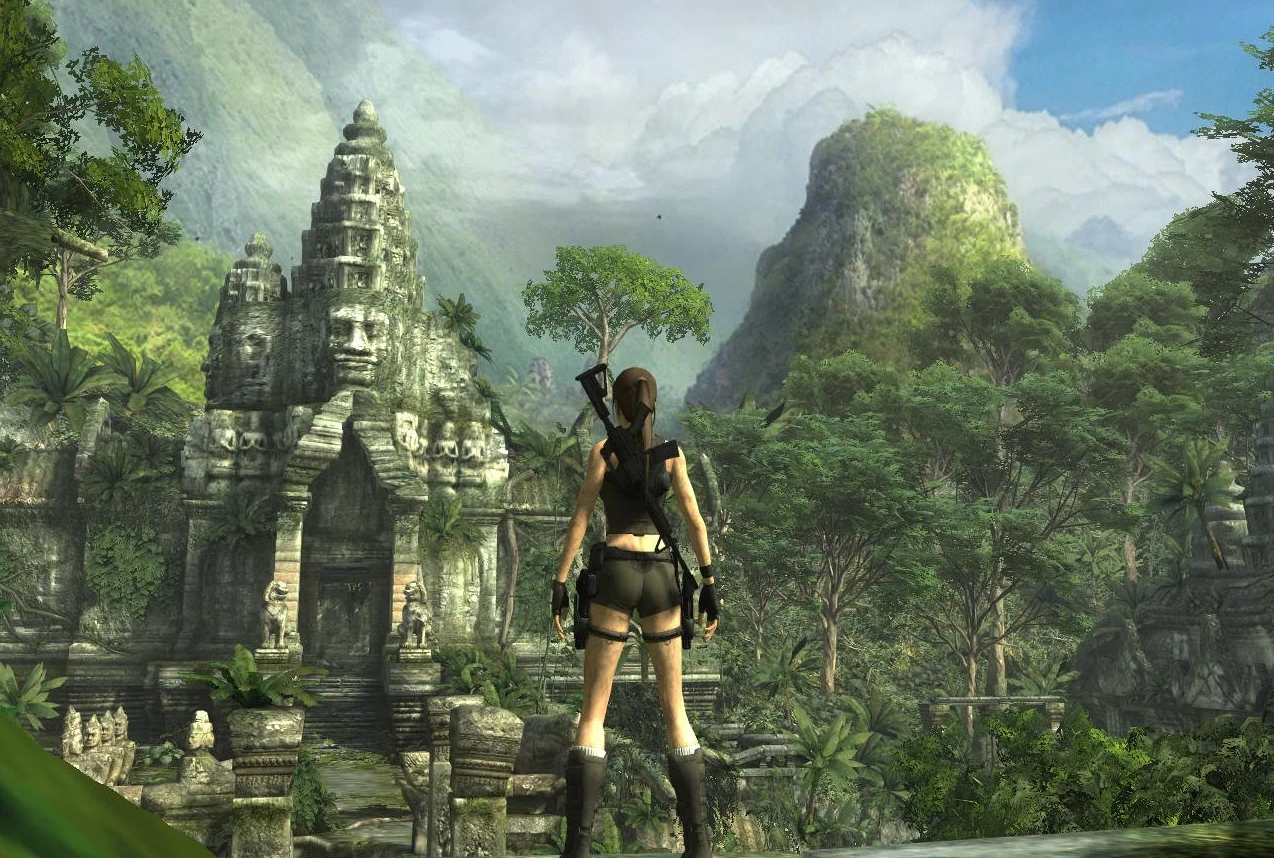
The games returned to Angkor in Tomb Raider: Underworld (2008), sending Lara back into the Khmer temples of the Cambodian jungle. Later spin-offs like Lara Croft: Relic Run kept the connection alive in smaller ways, including a Cambodia-themed loading screen for its temple stages.
Arcade and Fighting Game Classics
Before 3D graphics could render Angkor’s carvings in detail, 2D arcade and early fighting games were already using its silhouette as shorthand for “ancient and imposing.”
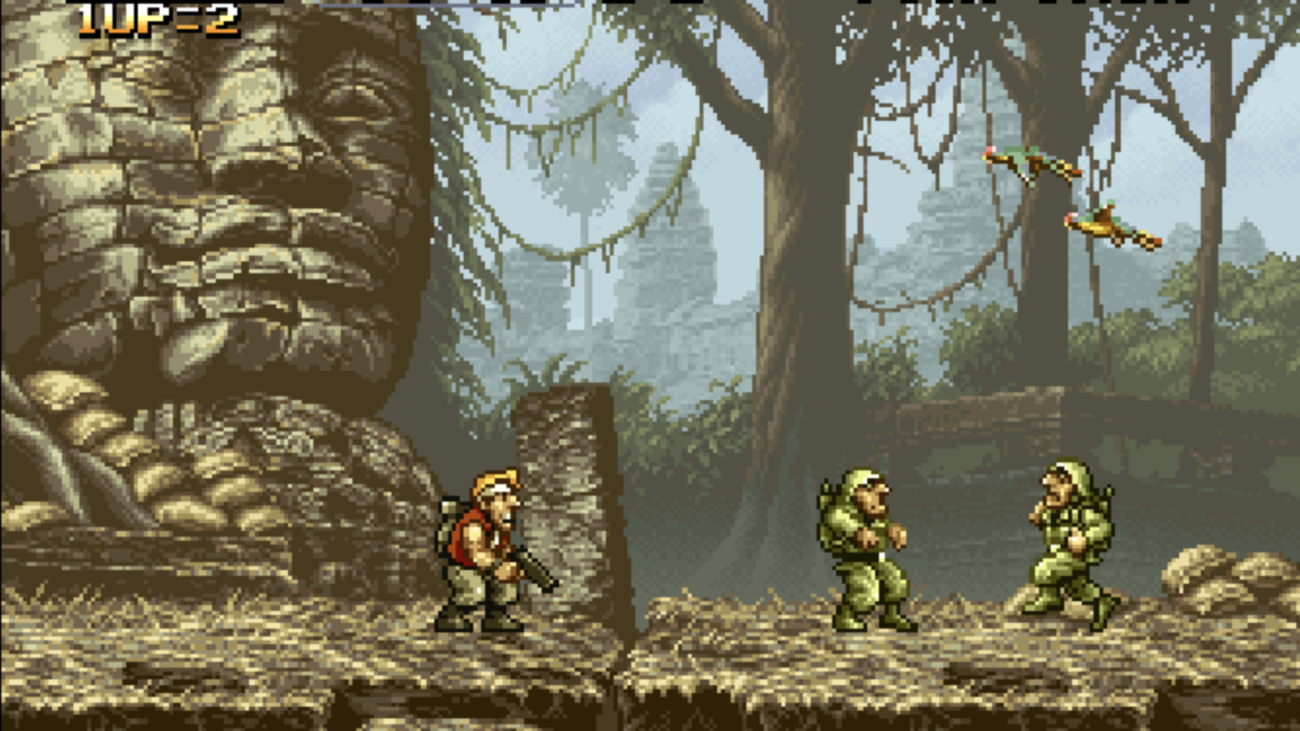
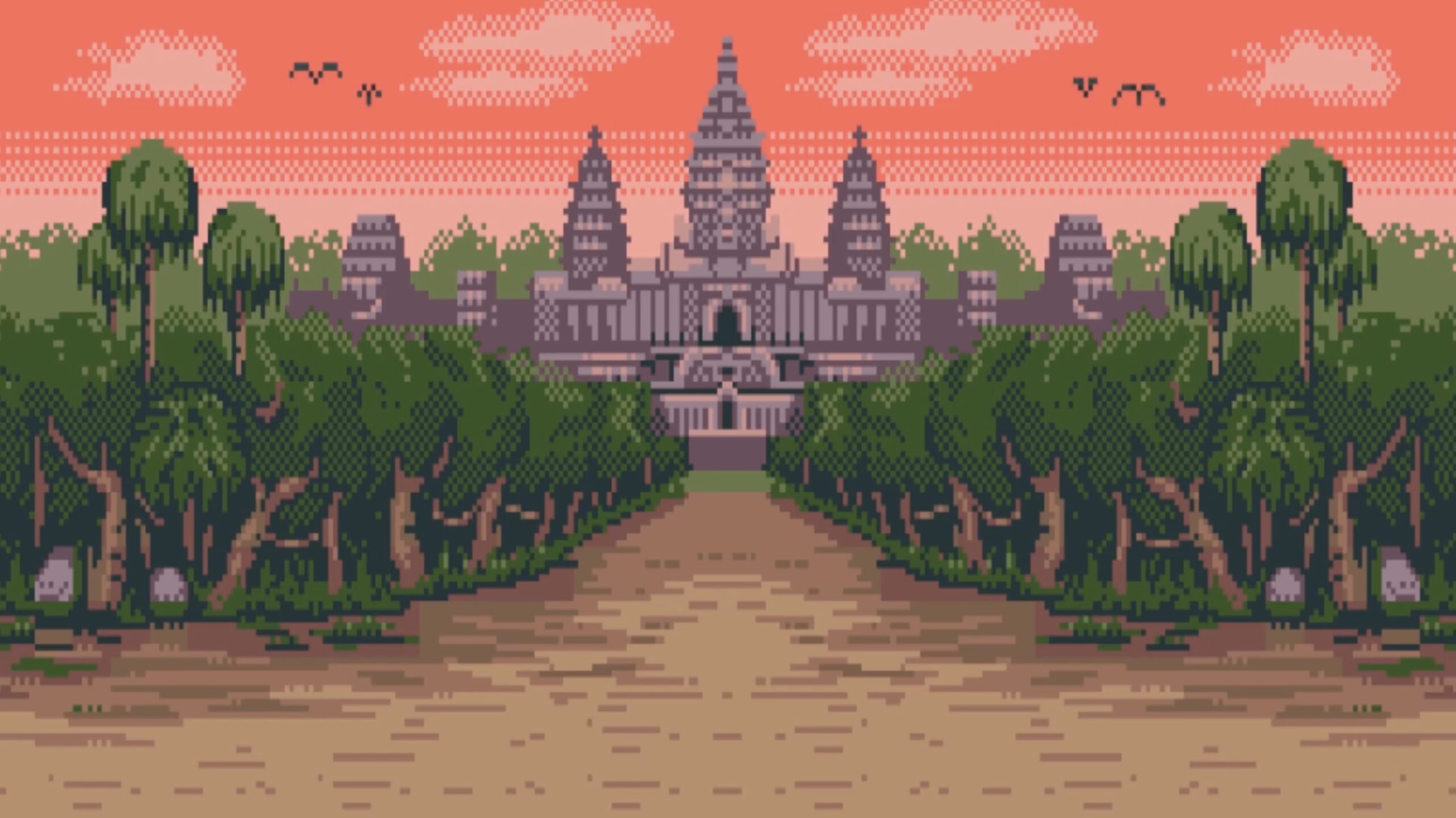
- Metal Slug: Super Vehicle-001 (1996) — SNK’s run-and-gun series opened its first mission with Angkor Wat and the Bayon’s faces in hand-drawn pixel art, as Marco and Tarma fight through General Morden’s forces. Metal Slug 3 later added two more Khmer-temple stages.
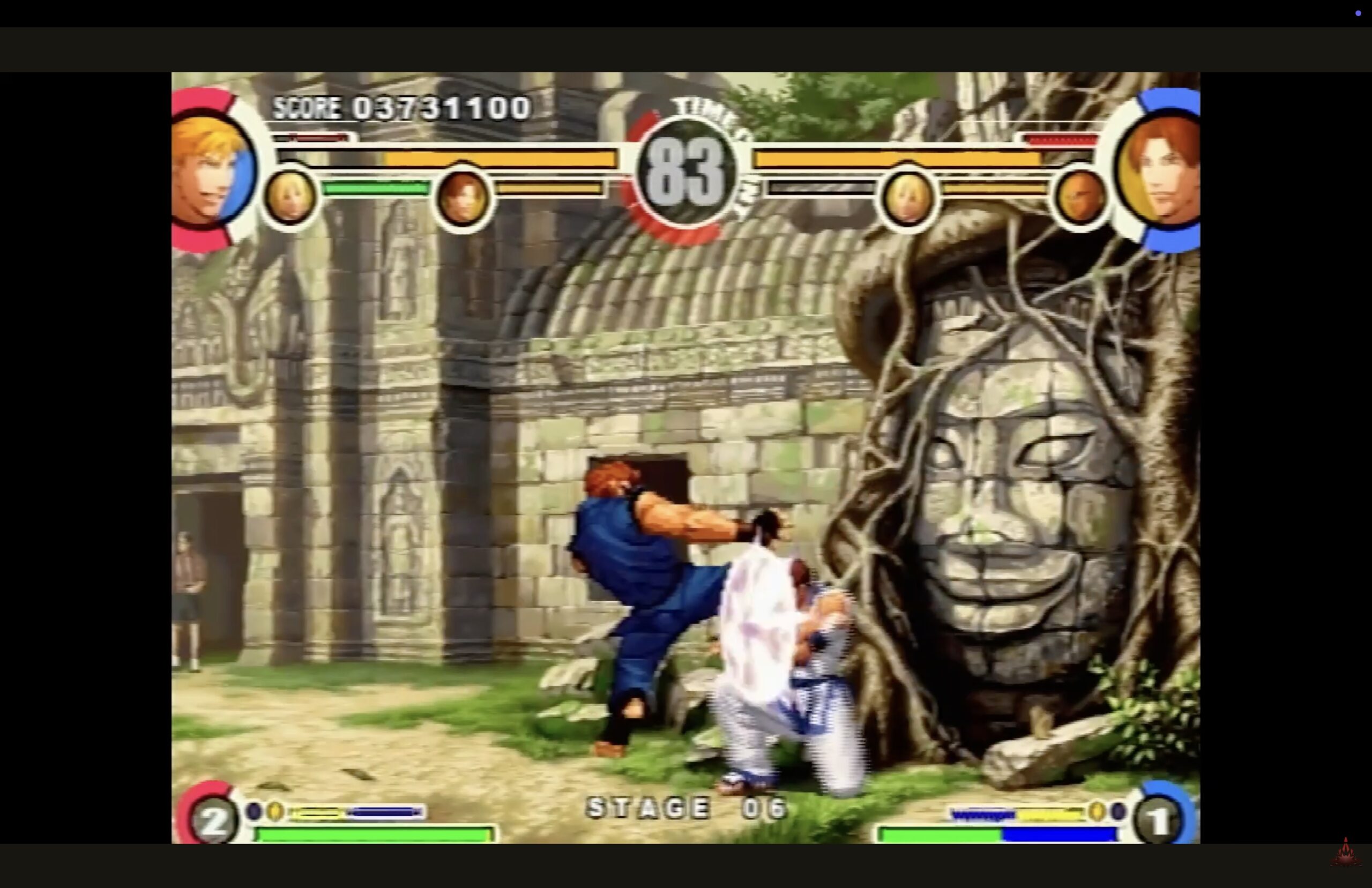
- The King of Fighters XI (2005) — One battle stage is set among the Angkor ruins, with a Bayon face wrapped in fig-tree roots, tourists taking photos, and local children cheering from the sidelines.
- SNK Gals’ Fighters — Reused Angkor-inspired backdrops from the same in-house art tradition at SNK.
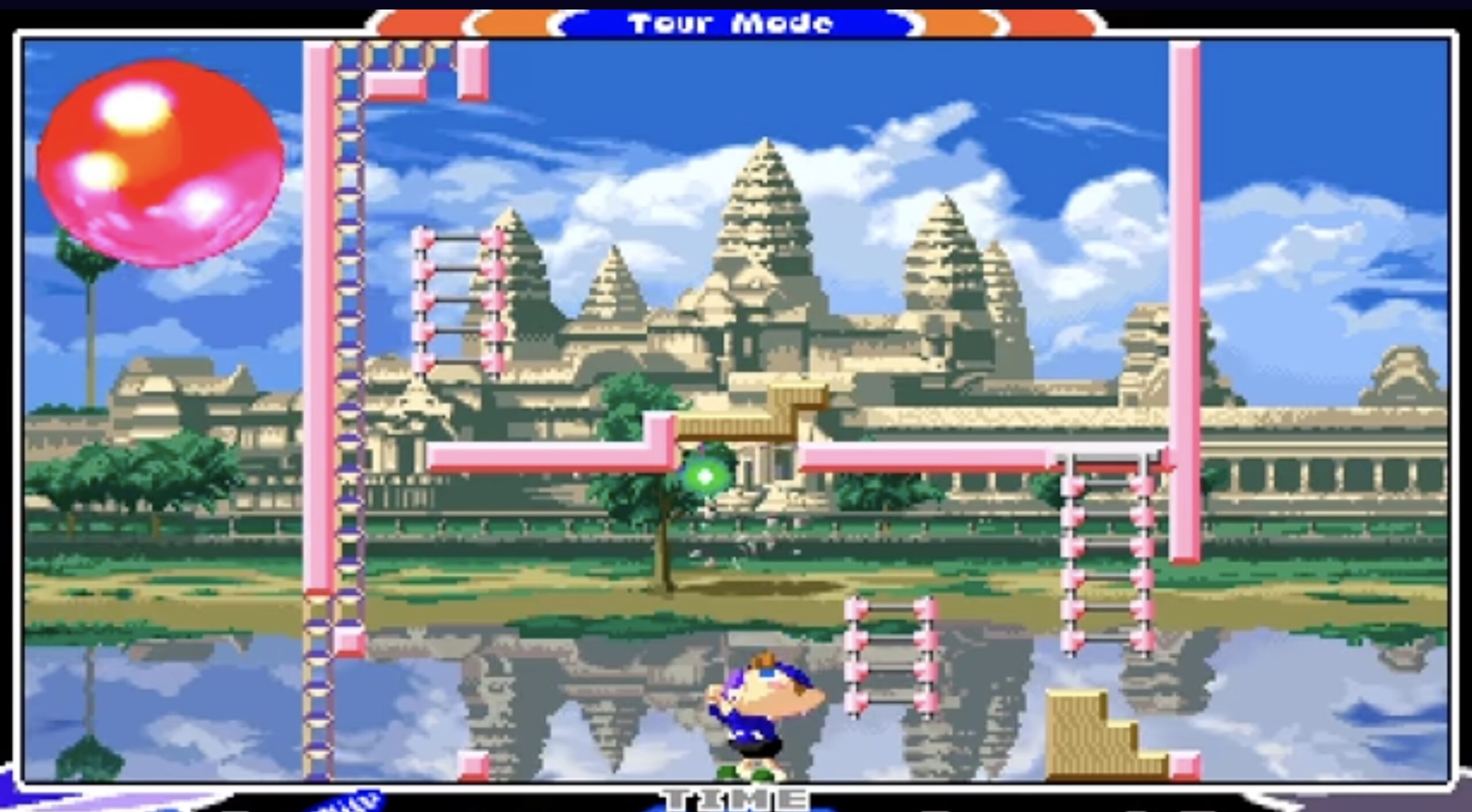
- Pang / Mighty! Pang — Featured an Angkor Wat stage as far back as its 1990 Amiga original, expanding into several Angkor-themed stages — a moat reflection at daytime, a sunrise backdrop, a dusk silhouette — by the time Mighty! Pang reached arcades.
- Broforce (2015) — A tongue-in-cheek entry: its second mission sends parody action heroes to a fictional “Cambrodium,” a generic jungle-temple stage leaning more on landmines and 80s action tropes than any specific Khmer architecture.
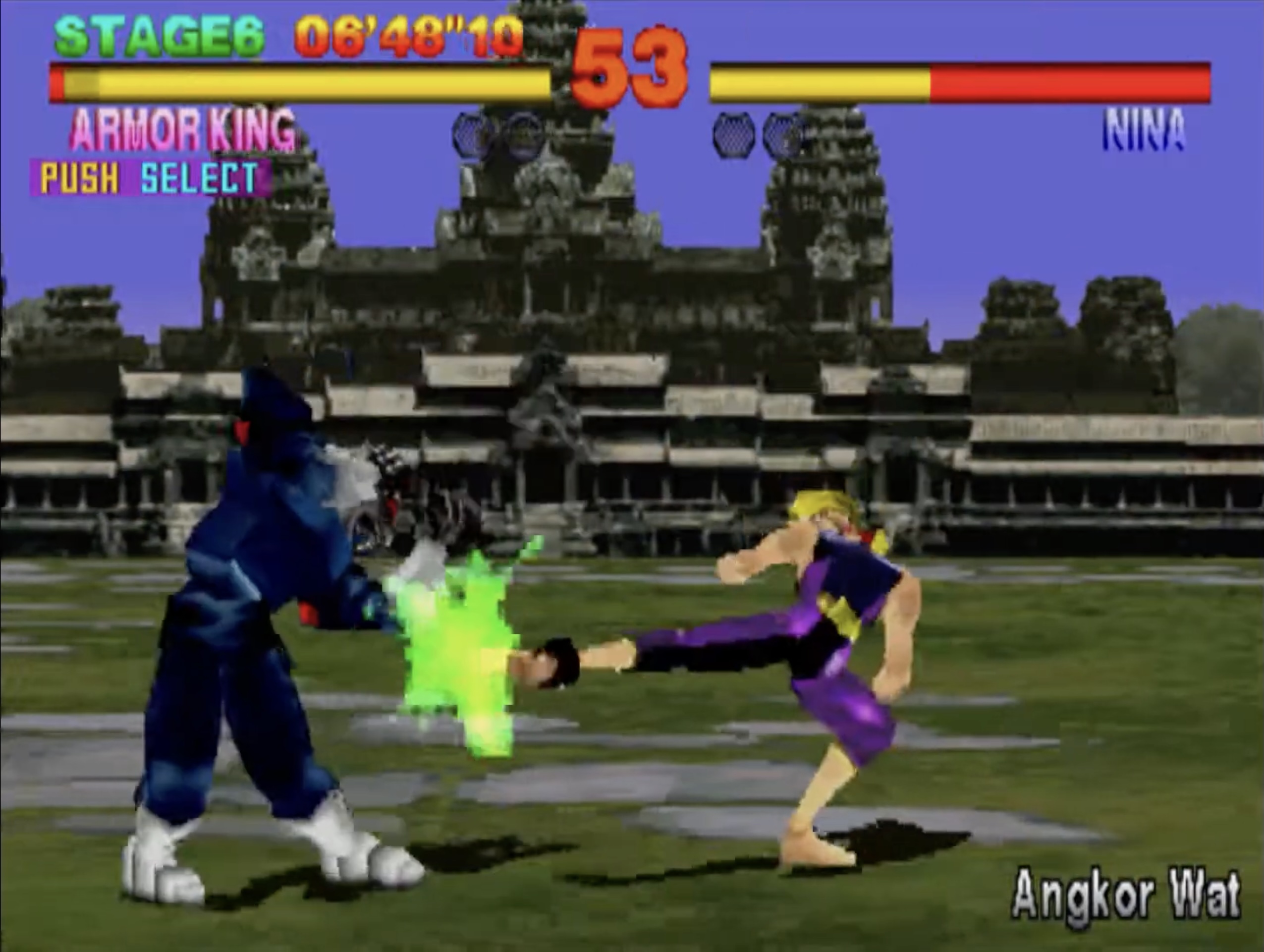
- Tekken (1994) — Namco’s original Tekken included an “Angkor Wat” stage, an open field set against a backdrop collage of the temple complex, used for fights like Paul vs. Yoshimitsu and Devil vs. Heihachi. Its music was reused a year later in Tekken 2 for Kunimitsu’s stage, “Cambodian Wetlands,” set in Kampong Thom province.
Temple Run: An Unofficial Homage That Became a Real-World Moment
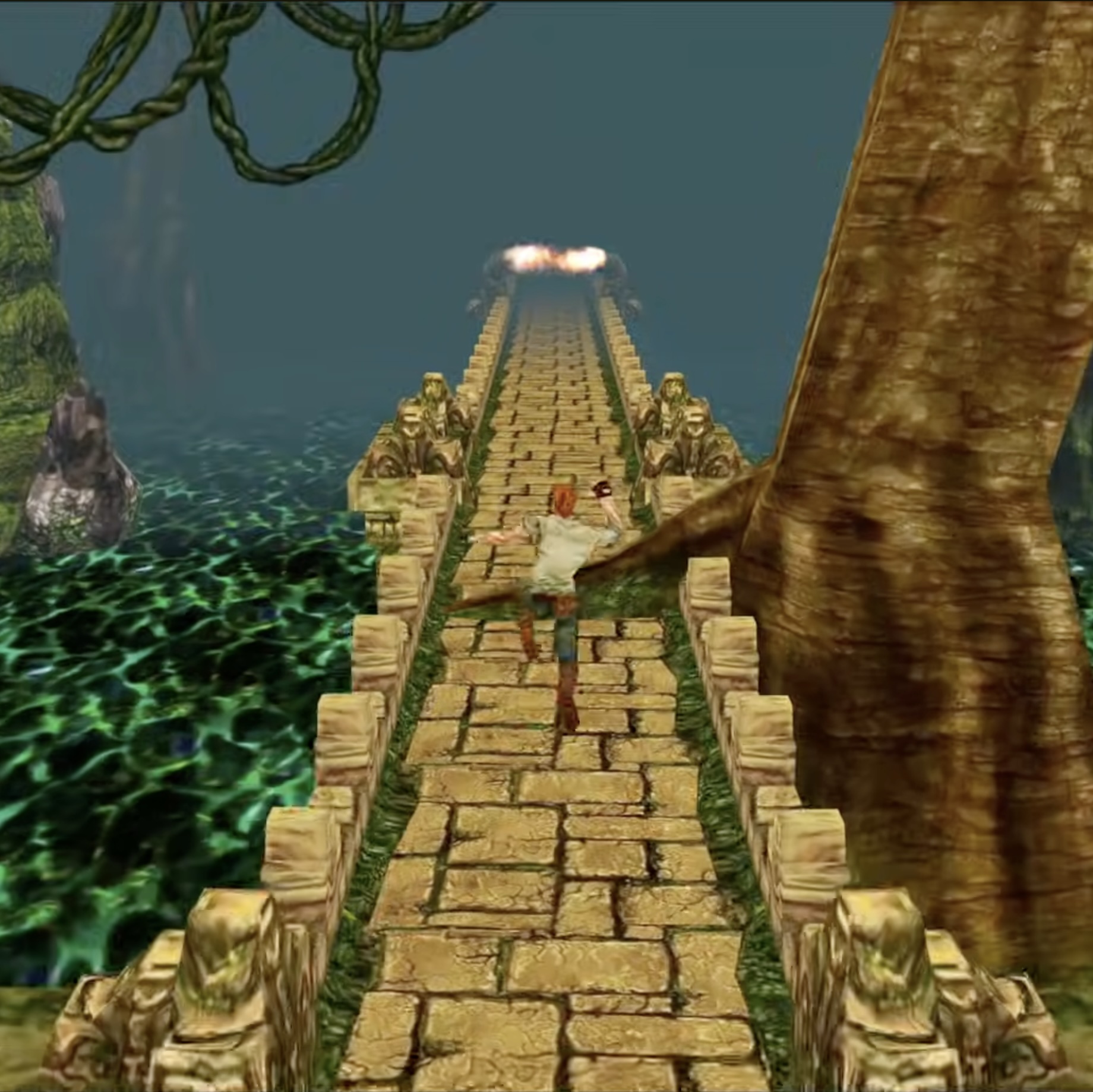
Temple Run, released by Imangi Studios in 2011, is an endless runner where an explorer sprints through ancient stone ruins, sliding and leaping while pursued by demonic monkeys after stealing a cursed idol. Imangi has never officially named Angkor Wat as the direct inspiration, but the resemblance — narrow stone corridors, jungle-swallowed passageways, tiered temple structures — has been close enough that players and Cambodians alike have drawn the connection for over a decade. The game and its sequel have been downloaded more than a billion times combined, and press coverage often describes its look as drawing on a blend of Indiana Jones and Tomb Raider as much as any single real location.
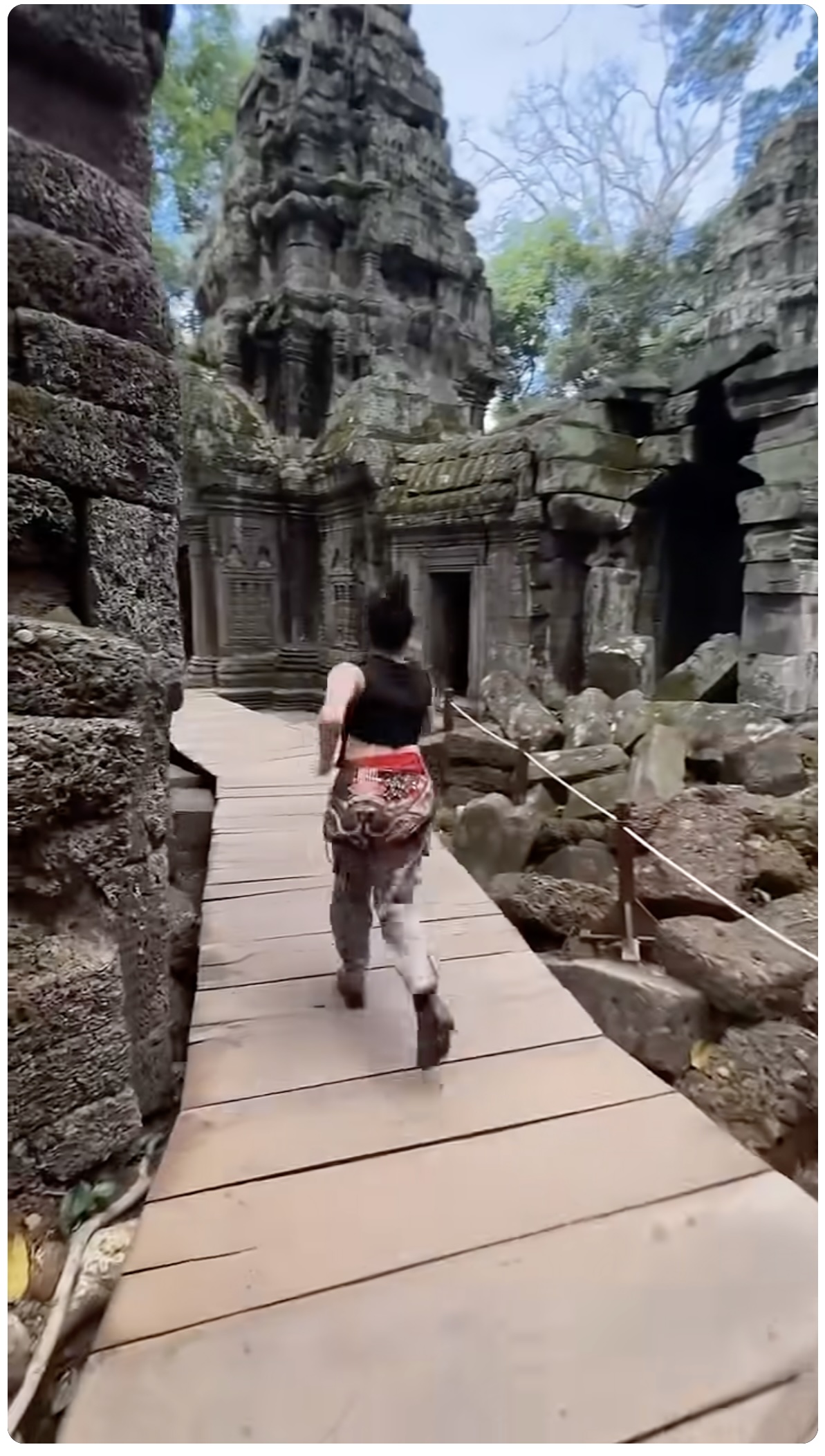
That resemblance became an actual cultural moment in 2024, when a TikTok trend had tourists at Angkor Wat and Ta Prohm filming themselves running and sliding through the temple corridors, often with the game’s soundtrack overlaid on the footage. Some clips reached millions of views, and reactions were mixed. Conservationists including Hans Leisen, who has led a German-funded conservation project at Angkor for three decades, and site conservationist Simon Warrack raised concerns about damage to 900-year-old carvings and about treating a living religious site the way one wouldn’t treat a church or mosque. Others, including Cambodian Prime Minister Hun Manet, took a more welcoming view, framing it as an organic form of tourism promotion at a time when visitor numbers were still recovering from the pandemic. Many Cambodian commenters online echoed that sentiment, thanking the creators for the exposure.
It’s a good example of how a game’s imagined version of Angkor looped back and reshaped how real visitors behave at the actual site — a case where the line between the game and the place got genuinely blurry.
Horror and Puzzle Games
Angkor’s temples have also suited horror and puzzle design well, where old stone, dense jungle, and buried secrets do a lot of the atmospheric work on their own.
- Eternal Darkness: Sanity’s Requiem (2002, GameCube) — A well-regarded horror-adventure game (produced with input from Shigeru Miyamoto) sets one of its four historical chapters in Angkor Thom. Khmer temple motifs appear throughout the walls and objects, blended with considerable artistic license into the game’s own mythology. It holds a Metascore of 92.
- Illusion of Gaia — Includes a fictionalized version of Angkor Wat as a late-game dungeon.
- Escape Hunt: The Lost Temples — A mobile escape-room game set in 1890, investigating a disappearance inside an “abandoned temple of the Khmer Kingdom,” styled after Angkorian art and architecture.
- Diamond Quest: Don’t Rush! — A casual puzzle-adventure (a remake of an older Gameloft title) using Angkor Wat’s temples as a backdrop for several levels.
Borrowed Architecture: Dark Souls and Diablo II
A few games absorb Angkor into their world-building without naming it directly. Dark Souls (2011) includes a late-game area, Lost Izalith — a ruined underground city wrapped in jungle roots, with spiraling stone towers rising out of the earth. Director Hidetaka Miyazaki has said in interviews that the area’s design drew on Angkor Wat, describing it as a place “where East and West Asia meet” and using it as the reference point for a more chaotic visual language, distinct from the ordered, cathedral-like architecture found elsewhere in the game. The resemblance to Ta Prohm and the wider Angkor Archaeological Park is clear enough to spot without knowing the background. Lost Izalith sits alongside Anor Londo’s debt to Milan Cathedral and the Duke’s Archives’ nod to the George Peabody Library as one of the series’ more direct real-world references — though it’s also widely known as one of the game’s rougher areas, a casualty of Dark Souls’ rushed late development.
Diablo II took a similar approach a decade earlier. In Diablo II: Lord of Destruction (2001), the Act V expansion sends players up Mount Arreat to the Worldstone Keep, whose architecture is noted as drawing on Angkor Wat — an odd pairing on paper, an icy mountain fortress modeled after a tropical temple, but consistent with how each act of Diablo II borrows from a real civilization: medieval Europe in Act I, ancient Egypt in Act II, and the Maya for Kurast in Act III. It’s worth being precise here: Kurast is Mayan-inspired, not Khmer, despite outwardly resembling a jungle temple complex. The Angkor reference is specific to the Worldstone Keep.
Made in Cambodia
Most of the games above were made outside Cambodia, using Angkor as an aesthetic borrowed from a distance. A smaller number of games have been made in Cambodia, by Cambodian developers, putting Khmer culture and language at the center rather than the backdrop.
- Angkor Kids — Cited as the first mobile game developed in Cambodia with Khmer-language text and speech. Set during the construction era of Angkor Wat, it casts players as a young villager learning period skills — farming, fishing, hunting, harvesting — while completing quests for family and fellow villagers. It became the most-downloaded game on Facebook in Cambodia at launch.
- Asva the Monkey (2012) — Developed by Osjoa Studio, it became Cambodia’s most-downloaded game on Apple’s App Store within two weeks of release. Players control Asva (“monkey” in Khmer), living in a forest near Angkor, and the game helped spark local interest in Cambodian game development.
- Angkorian — Billed as Cambodia’s first console-quality action game, set at the height of the Khmer Empire and stylistically inspired by titles like Devil May Cry, God of War, and Overwatch, while aiming for “a distinct Cambodian flavour.” Players choose between three heroes: Monny Cheychesda, a Bokator martial artist; Panchak Tepi, an archer; and Singhak Kiri, a hammer-wielding fighter. The story sends them after a demon, Tusakan, who has stolen the Sacred Crystal from a Temple of Light atop Kulen Mountain — a real and historically significant site, considered the birthplace of the unified Khmer Empire under Jayavarman II in 802 CE.
Beyond Games: Virtual Angkor
Outside the commercial gaming space, Virtual Angkor reconstructs the city as it likely appeared around 1300 CE, combining historical and archaeological research with 3D modeling and game-engine tools. It isn’t a game — there’s no combat or win condition — but it’s a useful contrast to everything above: rather than borrowing Angkor’s imagery for someone else’s story, it tries to reconstruct the real thing.
The Long Game
Taken together, these games show a few different relationships with the same source material. For some arcade developers, Angkor was simply distinctive scenery. For Firaxis and Microsoft’s strategy teams, it became a civilization worth building detailed, researched mechanics around. For Crystal Dynamics, it became the backdrop for a defining action-adventure moment — and, somewhat by accident, a genuine boost to Cambodian tourism. For a small number of Cambodian developers, it’s simply home ground: a setting worth building games for Khmer players, not only about them.
None of this makes any single game an authority on Khmer history — most take real liberties, and a few barely engage with it at all. But collectively, they’re a reminder of how far Angkor’s image has traveled, and how many different hands have shaped what people picture when they hear the name.
Media credit: