
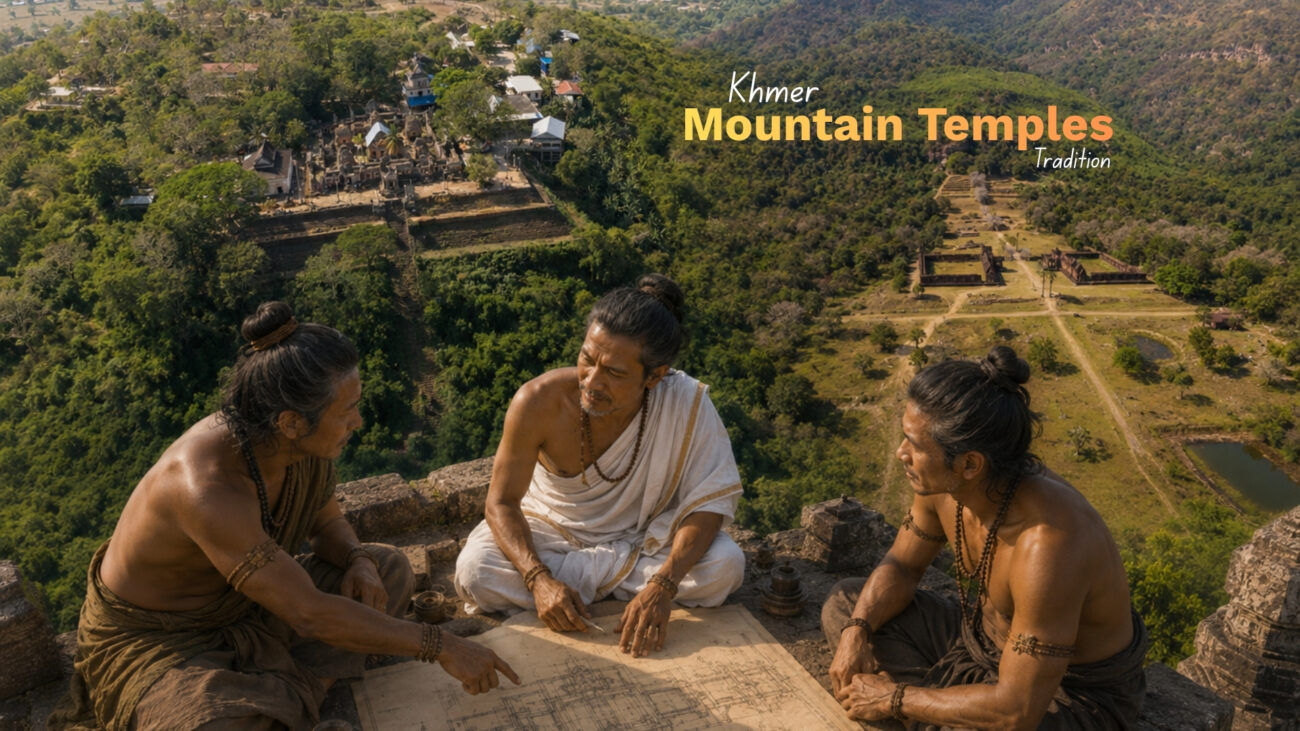
When people picture Khmer temple architecture, Angkor Wat usually comes to mind first — a vast rectangular monument rising from flat ground, its moat standing in for the cosmic ocean and its central tower for Mount Meru, home of the Hindu gods. But scattered across Cambodia and into southern Laos is a smaller, older, and in some ways more dramatic family of temples that didn’t need to simulate a mountain at all. They were simply built on one.
Preah Vihear, Phnom Chisor, and Wat Phu belong to this tradition. Rather than raising an artificial pyramid on level terrain, Khmer architects climbed an actual hill or cliff and let the landscape itself do the work of the cosmology — staircases following the natural ridge, gateways marking the ascent, and the most sacred sanctuary placed exactly where the mountain’s summit meets the sky. Understanding how this tradition developed, and why these particular sites were chosen, says as much about Khmer religious politics as it does about architecture.
The idea behind a “mountain temple” — and a “temple on a mountain”
Angkorian kingship was inseparable from a religious concept called the devaraja, or god-king, established in the early ninth century under Jayavarman II, the founder of the Angkorian empire. A king asserted his divine legitimacy in part by building a temple that placed him, ritually, at the summit of the universe — the peak of Mount Meru, where Shiva and the other gods reside. Most of the famous examples of this idea, like Angkor Wat or the earlier Bakong, are what scholars call “temple-mountains”: artificial stepped pyramids built on flat land to represent Meru symbolically.
Preah Vihear, Phnom Chisor, and Wat Phu represent a related but distinct approach — sometimes called “mountain temples” to distinguish them from temple-mountains. Instead of building the mountain, the architects found one. The first king to try this at scale was Yasovarman I (889–910), who placed his state temple, Phnom Bakheng, on a genuine hill overlooking his new capital, and built two smaller companion shrines on the only other nearby hills, Phnom Krom and Phnom Bok. It was a small but significant shift: rather than treating the terrain as an obstacle for construction to overcome, it became part of the design itself. This idea would later reach its most spectacular expression at Preah Vihear.
Preah Vihear (ព្រះវិហារ): 300 years of building on a single cliff
Preah Vihear sits atop the Dangrek Mountains, on a cliff roughly 525 meters above the plains, right along what is now the Cambodia–Thailand border. Its Sanskrit name, Sri Sikharisvara (ឝ្រីឝិខរីឝ្វរ ឬស្រីសិខរីស្វរៈ), means “Glorious Lord of the Mountain,” and it was dedicated to Shiva in his identity as the mountain-god Sikharesvara.
Construction did not happen in a single reign — it happened across roughly three centuries, with each generation of kings adding to what earlier ones had built. The earliest religious activity at the site is attested by an inscription (K.733) dating as far back as the sixth or seventh century, showing land and donations given to Shiva under a local Pashupata teacher — long before the Angkorian empire even existed. The mountain’s sanctity, in other words, predates the temple by centuries.
The Angkorian-era building program began under Yasovarman I around 893, and continued through the reign of Jayavarman IV in the tenth century, whose Koh Ker period left its mark in some of the earliest surviving stonework. Elements from the Banteay Srei style of the late tenth century are visible too, evidence of near-continuous work at the site. But it was Suryavarman I (1006–1050) who built the bulk of what stands today, and an inscription from 1018 (K.380) found on the temple’s pillars praises him and records that he installed his own personal linga there, alongside the temple’s chief deity. Suryavarman II, who a century later would build Angkor Wat, also enriched Preah Vihear substantially — an inscription (K.383) describes his spiritual advisor, the aged Brahmin Divakarapandita, donating a gold statue of the dancing Shiva (Nataraja), a jewel-inlaid gold dais, bronze floor plaques, and precious-metal wall decoration, and arranging for the temple’s towers and courtyards to be redecorated every year.
Architecturally, what makes Preah Vihear unusual among Khmer temples is its shape. Most Angkorian temples are compact, roughly square, and face east. Preah Vihear instead stretches along a single axis for about 800 meters, climbing the ridge through a sequence of five gopuras — gateway towers — each one built on higher ground than the last, connected by long causeways and staircases. A visitor moving through the complex physically re-enacts the ascent toward the sacred: each gopura marks a new, more restricted level of holiness, until the final sanctuary is reached at the summit, perched at the very edge of the cliff with the plains of Cambodia spread out below.
Phnom Chisor (ភ្នំជីសូរ): Suryavarman I’s southern sanctuary
About 50 kilometers south of Phnom Penh, in Takeo province, Phnom Chisor sits on a solitary hill roughly 100–130 meters high, reached today by a stairway of over 400 steps. In the eleventh century it carried a far grander name: Sri Suryagiri (ឝ្រីសូយ៌្យគិរី / ភ្នំស្រីសូរ្យ / ភ្នំជីសូរ) or Sri Suryaparvata (ឝ្រីសូរ្យបព៌ត ឬស្រីសុរិយបព៌ត) — “Mountain of the Sun.”
The temple was commissioned by Suryavarman I, the same king responsible for most of what stands at Preah Vihear, and it was one of several hilltop sites where he chose to install a personal linga, a practice tied directly to the devaraja cult and to marking his authority across the far reaches of his kingdom — in this case, the old Funan heartland near the Bassak River, well south of Angkor itself. Despite its solar name, inscriptions confirm the temple was dedicated primarily to Shiva, with a secondary dedication to Vishnu, reflecting the Brahmanic religious program Suryavarman I promoted throughout his reign.
Phnom Chisor’s layout is more compact than Preah Vihear’s, a difference partly dictated by the small, relatively flat hilltop it occupies. The temple proper is a tightly grouped complex of six brick towers: a central sanctuary opening east, surrounded by five secondary shrines also facing east, plus two structures — likely libraries — opening west, all enclosed within a laterite gallery. From the base, a monumental staircase begins at 7.5 meters wide and narrows gradually to 5 meters as it climbs, leading up through two cruciform gateways before reaching the summit. At the foot of the hill lie the remains of a baray, or reservoir, called Tonle Om — the ancient water source for the temple’s rites, and a reminder that even Khmer hilltop sanctuaries relied on the same hydraulic engineering that sustained temples on the plains.
Stylistically, Phnom Chisor is classified to the early eleventh-century Khleang style — named for a pair of buildings in Angkor Thom finished under Suryavarman I, known for comparatively simple lintels centered on a kala motif. It’s the same architectural vocabulary in use at Preah Vihear during Suryavarman I’s building campaigns there, which is part of why the two sites read as closely related despite being hundreds of kilometers apart.
Wat Phu (វត្តភូ / ວັດພູ): the sister temple across the border
Wat Phu lies near the Mekong River in what is now Champasak, southern Laos — geographically distant from both Preah Vihear and Phnom Chisor, but tied to them by the same royal hand. The mountain behind the temple has carried its Sanskrit name, Lingaparvata (លិង្គបព៌ត) (“Linga Mountain”), since at least the fifth century, after early worshippers recognized the shape of Shiva’s linga in its peak — making it, alongside Angkor’s own Phnom Kulen, one of the oldest continuously sacred sites in the region, predating the Angkorian empire itself. Numerous Khmer kings going back to the Chenla period had added to the site, but the most significant construction visible today, including the main shrine built onto an older brick sanctuary, dates from Suryavarman I’s reign, in a style effectively identical to what he built at Preah Vihear — down to matching lintel carving.
The connection between the two sites goes beyond shared architecture. Historical texts describe ceremonies performed simultaneously at Wat Phu and Preah Vihear, suggesting that consecrating a new linga at one site was paired with an equivalent ritual at the other — treating them as linked nodes in a single religious network rather than isolated, unrelated monuments. Like Preah Vihear and Phnom Chisor, Wat Phu is built into a hillside, its shrine set against the slope of Phou Kao (“Elephant Mountain”), with a processional causeway leading up from the plain toward the summit sanctuary — the same ascending, axis-driven design principle repeated a third time, in a third country.
Related hilltop sites worth knowing
Preah Vihear, Phnom Chisor, and Wat Phu are the clearest and most fully developed examples of this tradition, but they aren’t the only ones. Several other Khmer temples share the same core idea — a sanctuary set on genuine high ground rather than an artificial platform — even if none quite matches the scale of the three sites above.
Phnom Bakheng, Phnom Krom, and Phnom Bok (ភ្នំបាខែង ភ្នំក្រោម ភ្នំបូក) — Yasovarman I’s original trio, and the starting point of the whole idea. Phnom Bakheng combines a real hill with an added pyramid and the classic five-tower quincunx representing Mount Meru; Phnom Krom overlooks the Tonle Sap and was dedicated jointly to Shiva, Vishnu, and Brahma; Phnom Bok, the least restored of the three, still requires a 635-step climb. Together they mark the moment Yasovarman I decided a temple-mountain worked even better when it sat on an actual mountain.
Chau Srei Vibol (ចៅស្រីវិបុល) — a lesser-known but architecturally significant site about 16 kilometers east of Angkor, on the old royal road toward Beng Mealea. It sits atop a steep natural hill roughly 20 meters high, ringed by a wide moat and a laterite enclosure wall with gopuras at each cardinal point, with the central sanctuary and a “library” building at the summit. Though badly ruined today — as much from 20th-century conflict as from time — its layout, materials, and stylistic hallmarks point clearly to the Suryavarman I / Baphuon-era building tradition, placing it firmly in the same family as Preah Vihear and Phnom Chisor, even without a surviving foundation inscription to confirm the exact patron.
Phnom Banan (ភ្នំបាណន់) — in Battambang province, built by Udayadityavarman II, Suryavarman I’s son. Its five towers deliberately echo Angkor Wat’s layout, reached via a naga-flanked laterite staircase climbing the hillside — evidence the hilltop tradition persisted into the next generation.
Phnom Kulen (ភ្នំគូលែន) — less a single temple than an entire sacred plateau, and arguably the spiritual starting point for all of Khmer sacred-mountain architecture: it was here, in 802 CE, that Jayavarman II declared independence from Java and founded what became the Angkorian empire. Rather than one unified complex, Kulen scatters shrines, riverbed carvings, and a reclining Buddha across the mountain itself.
Phnom Rung (វ្នំរុង / ភ្នំធំ / พนมรุ้ง) — just across the modern border in Buriram, Thailand, and already mentioned above: the clearest descendant of the Preah Vihear formula, using the same causeway-gopura-summit sequence a century later.
Why the same design shows up in three places
None of this is coincidence. Preah Vihear, Phnom Chisor, and Wat Phu form a deliberate architectural and political network built substantially under one king, Suryavarman I, in the first half of the eleventh century. Each site combines the same core elements: a real elevated landform rather than an artificial one, an axial causeway rather than a compact concentric plan, a sequence of gateways marking increasing sanctity, and a summit shrine housing a personal royal linga tied to the devaraja cult. Positioning these temples on the empire’s northern, southern, and eastern edges — the Dangrek range, the Takeo hills, and the Mekong valley — let Suryavarman I project his religious and political authority to the very borders of his kingdom, using the same architectural language everywhere he built.
The idea didn’t end with him. Later temples like Phnom Rung, in what is now Buriram province in Thailand, continued the same causeway-and-summit-sanctuary formula into the twelfth century, built during roughly the same period as Angkor Wat itself. Even as Khmer architecture moved toward the flat-ground, moat-and-pyramid temple-mountains that would define Angkor Wat and the Bayon, the older tradition of finding — rather than building — a mountain never fully disappeared. Its clearest and most spectacular survivors are still standing at Preah Vihear, Phnom Chisor, and Wat Phu today.